Higher productivity
Reduce fragmented tracking and repeated administrative effort.

Global Search
Coordinate production planning, materials, work orders and quality with clearer records, responsibilities and oversight.
Production planning, materials, work orders and quality. Explore how this application can help coordinate everyday activities, improve information access and support better business decisions.
Industry workflows often involve unique records, operational checkpoints, approvals and reporting requirements. The first design task is to map these stages rather than impose a generic process.
Specialist teams can work through agreed steps with clear ownership, while managers gain visibility into exceptions, turnaround times and service outcomes.
For organisations with specialised industry processes, the right implementation can make daily work more consistent and give management clearer operational insight.
Reduce fragmented tracking and repeated administrative effort.
Identify exceptions and improve operational oversight.
Use consistent records and relevant management reporting.
Define responsibilities, permissions and review checkpoints.
The final architecture depends on the organisation's existing systems, security needs, integrations and deployment requirements.

Coordinate demand, bills of materials, work orders and capacity.
Track raw materials, work-in-progress and finished stock.
Plan inspections, production variances and batch traceability.
Map the processes specific to your organisation.
Maintain structured, searchable business information.
Configure responsibilities and review points.
Manufacturing ERP can be evaluated for organisations with specialised industry processes. The specific workflows, records, approvals and reporting requirements depend on your industry and operating model.
Depending on technical feasibility, this application may exchange information with accounting, customer management, reporting, payment or operational systems.
Delivery planning considers infrastructure, migration, user training, acceptance testing and support arrangements. Available hosting and configuration options are confirmed during consultation.
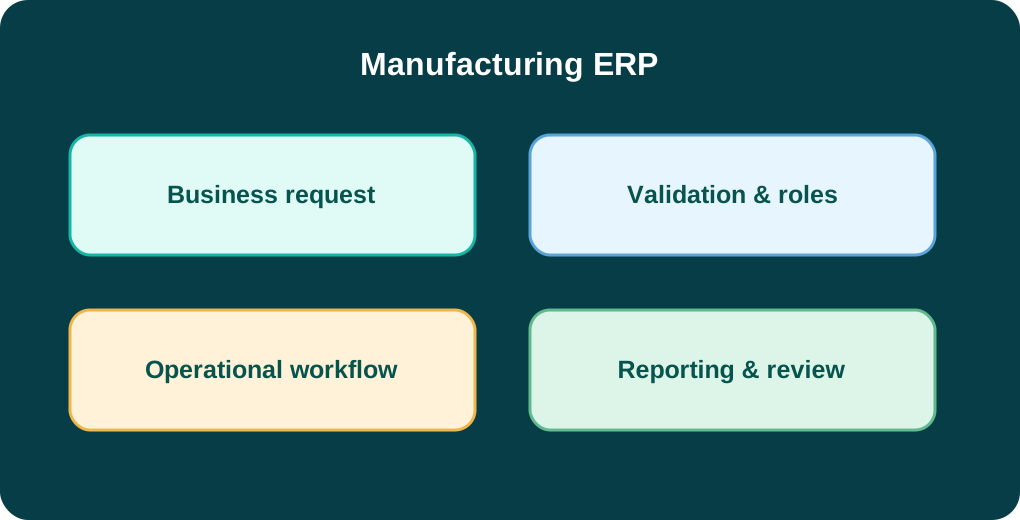
Manufacturing ERP is intended for production planning, materials, work orders and quality. A key area to assess is production planning: Coordinate demand, bills of materials, work orders and capacity. The final functionality depends on the agreed implementation scope.
The catalogue lists Industry solution. These are catalogue labels, not a verified feature-by-version specification. Share your team size, locations and workflows so the appropriate option can be confirmed.
Integration feasibility depends on the systems involved, available APIs, data formats, security requirements and implementation scope. Provide the systems you use so compatibility can be assessed before quotation.
The proposed rollout for your industry systems organisation should be defined after reviewing data quality, user roles, hosting needs, training requirements and support expectations. Timelines and commercial terms are confirmed in a tailored proposal.
Tell us about your processes, team and objectives. We can discuss configuration, integration and delivery options.
Request a tailored demo →Browse other products →